
Brown-throated Sloth Facts (Bradypus variegatus)
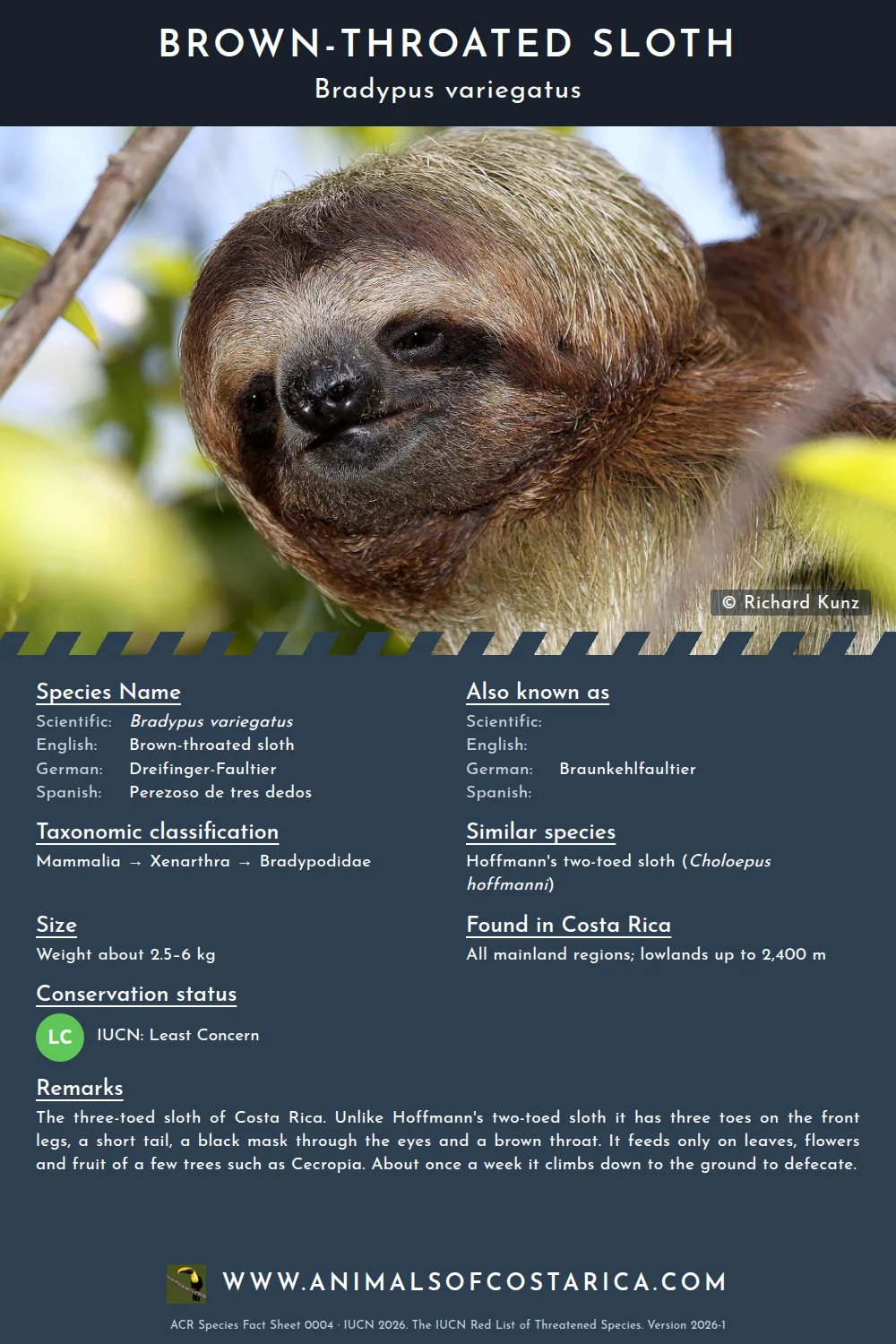
The Brown-throated Sloth (Bradypus variegatus) is often active by day and rests in open tree crowns, so it is the sloth most visitors see.
About the Brown-throated Sloth
Three toes on the front legs, a short tail, a black mask through the eyes and a brown throat tell it apart from Hoffmann’s two-toed sloth. Males have a patch of orange and brown fur in the centre of the back. Adults weigh about 2.5–6 kg. The diet consists only of leaves, flowers and fruit of a few trees, among them Cecropia, and is digested very slowly. About once a week the sloth climbs down to the base of its tree to defecate. Three-toed sloths have up to nine neck vertebrae instead of the usual seven and can turn the head through about three quarters of a circle.
Conservation status
The species is listed as Least Concern on the IUCN Red List.
Source: IUCN 2026. The IUCN Red List of Threatened Species. Version 2026-1.
Where to see it in Costa Rica
Common in the lowlands and found up to 2,400 m. Good places are Cahuita, Tortuguero, Manuel Antonio and the Caribbean lowlands in general, where it often sits in Cecropia trees.
Download the fact sheet
The fact sheet above is available as a free PNG image. Share it freely with naturalists, students and guides.
For more photos and the other species of Costa Rica, see the Animals of Costa Rica App, available on Google Play and the App Store.

Frequently asked questions
How big is a brown-throated sloth?
Adults weigh roughly 2.5 to 6 kg. The arms are much longer than the legs.
What do brown-throated sloths eat?
Only leaves, flowers and fruits of a limited number of trees, among them Cecropia. The food is digested very slowly.
How do you tell a three-toed sloth from a two-toed sloth?
The brown-throated sloth has three toes on the fore legs, a short tail, a black mask through the eyes, a short snout and a brown throat. Its fur is greyish, while that of Hoffmann's two-toed sloth (Choloepus hoffmanni) is brownish.
Why do sloths climb down from their tree?
About once a week the sloth climbs down to the base of its tree to defecate, a risky habit that is still not fully explained.
Can sloths swim?
Yes, sloths swim well.
Why do sloths look green?
Algae growing in the coarse outer hair often give the coat a greenish tinge.
Where can you see sloths in Costa Rica?
Good places are Cahuita, Tortuguero, Manuel Antonio and the Caribbean lowlands in general, where it is often found in Cecropia trees. The species is common in the lowlands and occurs up to 2,400 m.